

The Problem
DeFi lending is scaling. Billions deployed. Publicly traded companies offering it to retail.
But there's a conversation happening behind closed doors at every one of these companies:
"What happens when something goes wrong?"
Right now, the answer is nothing. Users just lose.
Everyone is quietly terrified of the same thing: the next hack, fraud, curation failure and headline.
By and large, suppliers on DeFi lending platforms are exposed to binary risk. There's no middle ground, no structured protection, no way to right-size your exposure.
We're scaling on hope. That's not a foundation, it's a prayer.
The Principle
Every mature financial system solved this problem decades ago: structured loss absorption.
Insurance has reinsurance. Banks have capital tiers. Derivatives have margin waterfalls. When losses occur, they flow through layers. Each one absorbs what it can before passing the remainder to the next.
DeFi hasn't built this yet. Users sit at the bottom of a structure with no layers above them. When something breaks, they take all of the loss.
We're bringing this proven architecture to DeFi. We call it the Safety Stack.
The Framework
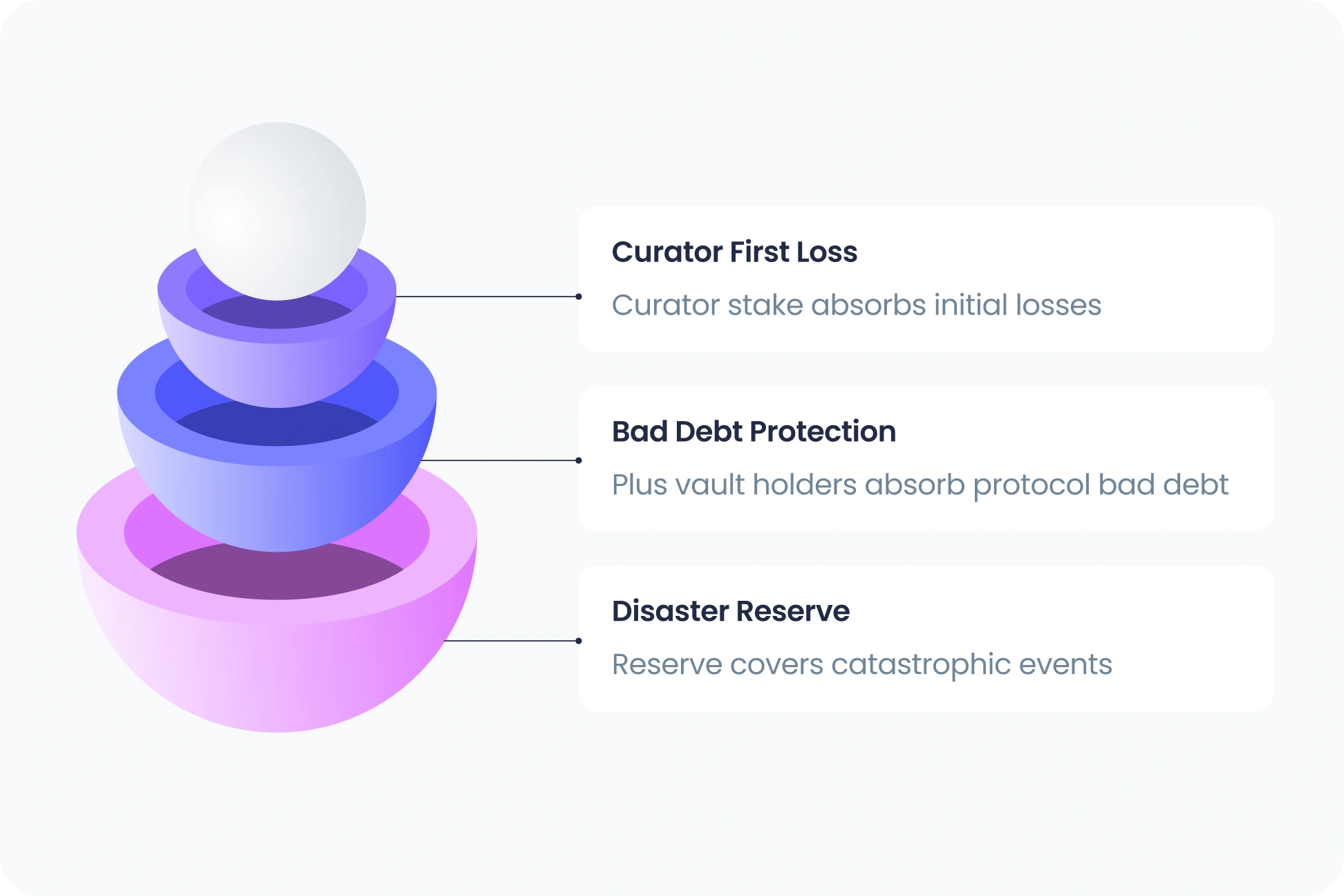
The Safety Stack composes multiple layers of defense so that losses are absorbed progressively.
Layer 1: Curator First Loss
Risk curators put their own capital on the line. They absorb initial losses before any user funds are touched. This aligns incentives and protects users.
Layer 2: Bad Debt Protection
A second layer of capital stands ready to cover bad debt. Users who want higher yields can provide this protection and earn for doing so.
Layer 3: Disaster Reserve
A backstop for catastrophic events—smart contract exploits, black swan market conditions, systemic failures. The last line of defense.
Each layer protects the one above it. The result: users can finally choose their position on the risk curve.
Before and After
November last year, Stream Finance collapsed. $93 million gone with xUSD crashing 85% overnight.
Because xUSD had been accepted as collateral across Morpho and Euler vaults, the contagion spread—$285 million in exposure across the ecosystem. Depositors found funds locked at 100% utilization. Others took 3.5% to 12% haircuts.
The Safety Stack changes this.
You deposit $100k. You earn yield. Something breaks. But before your capital is touched:
- The curator's own funds absorb first losses—real skin in the game
- A dedicated protection layer covers bad debt
- A disaster reserve backstops what's left
Your deposit stays whole. Same underlying markets. Completely different risk structure.
This is how you build something that lets everyone—depositors, curators, platforms—sleep at night.
Pick Your Spot
The Safety Stack doesn't just protect depositors—it creates a market for protection.
Someone has to fund those protection layers. In exchange, they earn higher yields for taking on the risk that would otherwise hit passive depositors.
This turns binary risk into a spectrum of choices:
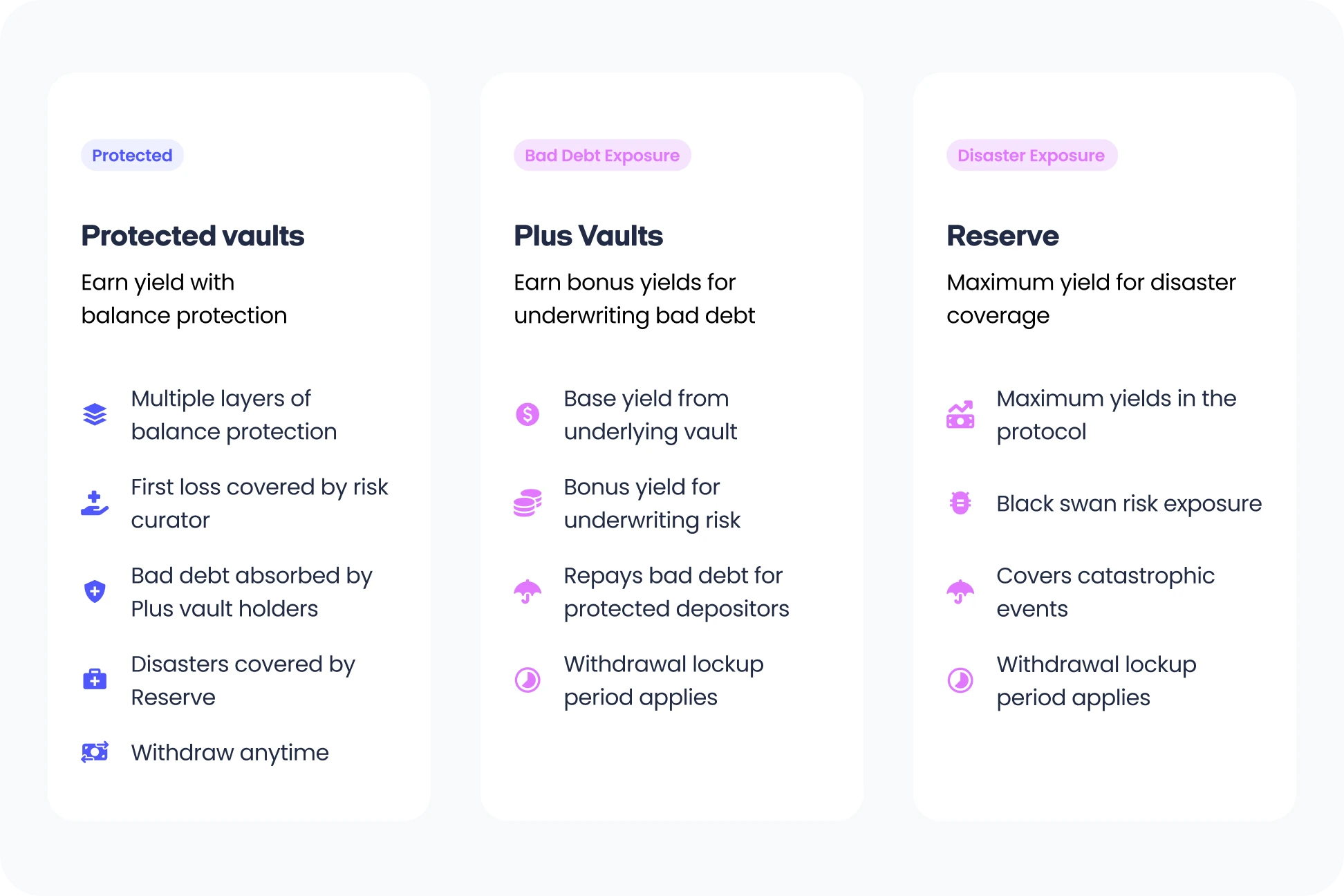
Protected Vaults earn competitive yields with layered protection. You're paying for safety—and you can actually model the risk.
Plus Vaults earn higher yields by covering bad debt. You're selling protection to those who want it.
Reserves earn outsized yields by backstopping disasters. You're underwriting tail risk with eyes open.
Want safety? Deposit in a Protected Vault and sleep at night. Want yield? Provide the protection others are paying for.
We’ll be sharing more about these opportunities to earn yield in the coming weeks.
What's Next
We're launching the first vaults that incorporate the Safety Stack.
Get in touch if you're:
- building products that need defensible DeFi yield
- allocating capital that needs structured protection and transparent risk tranches.
- or curating risk and want to offer your depositors real protection that differentiate your vaults
